

Best cardiologists in Tampa Bay: what to look for and what to ask
If you are having chest pain or pressure right now, shortness of breath, or pain spreading into your arm, neck or jaw, stop reading and call 911. Do not drive yourself, do not wait for a callback, and do not book an appointment. That is an emergency room situation, not a scheduling situation.
For everything else, here is the honest answer to the question you typed. There is no single best cardiologist in Tampa Bay, because cardiology is not one job. The right cardiologist for you depends on which subspecialty your problem falls under, and once you know that, the search gets much narrower and much easier. A rhythm problem, a blocked artery, a leaky valve and a cholesterol number each go to a different kind of cardiologist, and the most accomplished doctor in the wrong lane is still the wrong doctor.
Why "best" sends you in circles
Search for the best cardiologist and you get star ratings, paid listings and awards nobody can explain. None of that tells you whether the person is the right fit for your heart question. What actually predicts a good outcome, matching your problem to someone who treats it every week, never shows up in a ranking.
So change the question. Instead of "who is the best," ask "what kind of cardiologist handles this?"
The subspecialties, and which problem goes where
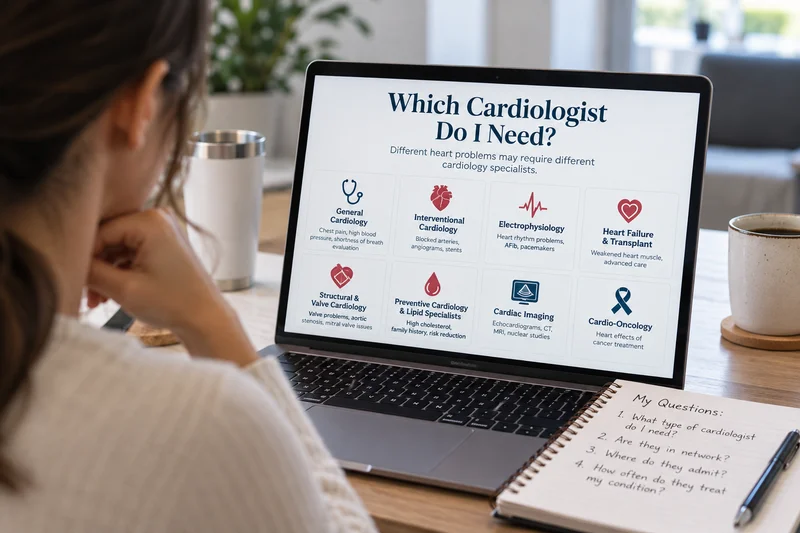
Every cardiologist completes internal medicine training and then cardiology training. After that, most go further. Here is the split, in plain terms.
General or clinical cardiology. This is the front door. General cardiologists evaluate chest pain, high blood pressure, murmurs, abnormal EKGs, shortness of breath and risk assessment before surgery. They order and read the first round of testing and decide who needs a subspecialist. If you do not yet know what is wrong, this is usually where you start.
Interventional cardiology. These are the catheter doctors. They do angiograms, place stents and open blocked coronary arteries. You end up here when testing points to blockage in the arteries feeding the heart.
Electrophysiology. Rhythm specialists. Atrial fibrillation, racing heart, skipped beats, fainting, pacemakers and defibrillators, and ablation procedures all live here. If your main complaint is that your heartbeat feels wrong rather than that your chest hurts with exertion, an electrophysiologist is often the right destination, though a general cardiologist usually confirms that first. See our piece on heart palpitations and when to stop waiting, and if you already have a diagnosis, our overview of atrial fibrillation.
Heart failure and transplant cardiology. For a weakened or stiff heart muscle, a low ejection fraction, repeated fluid buildup, or advanced therapies. If you have been hospitalized more than once for fluid, this is the lane.
Structural and valve cardiology. Aortic stenosis, mitral valve problems, holes between chambers, and the catheter-based valve repairs. Often works as a team with cardiac surgeons.
Preventive cardiology and lipid specialists. Stubborn cholesterol, family history of early heart disease, high lipoprotein(a), and risk reduction when you have not had an event yet. Useful if the goal is to never need the other subspecialties.
Cardiac imaging. Echocardiography, cardiac CT, cardiac MRI and nuclear studies. You usually do not choose this doctor directly, but their reading drives everyone else's decisions.
Adult congenital heart disease. For adults born with a heart defect, including those repaired in childhood. A small and separate field, and general adult cardiology is not a substitute for it.
Cardio-oncology. For heart effects of cancer treatment, which matters in a region with a large cancer center population.
One more thing worth knowing. A cardiothoracic surgeon is not a cardiologist. Cardiologists diagnose and treat with medication and catheters. Surgeons open the chest. You generally meet the surgeon after the cardiologist, not instead of.
What to ask when you call, and at the first visit
Say these out loud. The scheduler can answer the first three.
- "Is this doctor a general cardiologist, or do they have a subspecialty? Which one?"
- "My main problem is [your symptom in your own words]. Is this the right doctor for that, or should I be seeing someone else in the practice?"
- "Are you in network with my plan, and is the hospital where you do procedures also in network?"
- "How often do you treat this specific problem?"
- "If I need a procedure, do you perform it, or do you refer out? To whom?"
- "What test comes next, and what decision will the result help us make?"
- "Who do I call if something changes before my follow up, and who covers for you?"
Credentials and signals that genuinely matter
Board certification. Confirms the doctor completed accredited training and passed the exam in internal medicine and cardiovascular disease. Subspecialty certification exists for interventional cardiology, electrophysiology and advanced heart failure. Certification tells you the training was real. It does not tell you how good the person is with patients.
Volume in your specific procedure. How often a doctor performs the thing you may need is a fair question to ask directly.
Hospital affiliation. Where a cardiologist has privileges determines where your procedure happens and where you land if you are admitted. Tampa General, AdventHealth, BayCare and Moffitt are the major systems across Hillsborough and Pinellas, and a doctor's affiliation is a logistics fact, not a quality grade. Ask where they admit and whether you can get there easily from South Tampa, Brandon, Carrollwood, Clearwater or wherever you actually live.
Insurance participation. Confirm with your plan, not just the office. [VERIFY: confirm network status directly with your insurer and ask whether the facility and the physician are billed separately]
Communication style. If you leave unable to explain your own plan, the fit is wrong regardless of credentials.
What to bring to the first appointment
Bring your medication list with doses, including supplements. Bring copies of any EKGs, echocardiograms, stress tests or cardiac CTs, and the actual images on a disc or portal link rather than just the report. Bring a blood pressure log if you have one. Bring your insurance card and photo ID. Write down your three most important questions. If memory or hearing is a factor, bring someone with you. More in our guide to preparing for a specialist appointment.
How to verify any of this yourself
You do not have to take anyone's word for it. Three public tools do most of the work.
The ABMS certification lookup confirms whether a physician is board certified and in which specialties and subspecialties. The Florida Department of Health license verification shows whether a license is active and in good standing and surfaces public disciplinary action. Medicare Care Compare provides federal information on physicians and on hospitals, including facility level measures relevant to where a procedure would happen.
You can also browse specialty specific physician information here: [LINK: Compass physician directory, cardiology page]
Sorting out which subspecialty you need, getting the records moved, and finding an opening sooner than the first one offered is a real amount of work. Compass Health is a Tampa Bay membership service that does that part for members, including identifying the right subspecialist, booking the appointment, and coordinating between doctors who are not talking to each other. It is not insurance and not a medical practice, and your own physician remains the authority on anything clinical.
📞 (813) 567-8778 · 🌐 thecompasshealth.com